
Creator
Curaçao betting sites are online bookmakers operating under Curaçao's gambling licensing framework. Comparing them means looking beyond the casino lobby: sports markets, accepted odds, settlement rules and withdrawal conditions determine the betting experience. For UK players, a Curaçao licence is separate from the Gambling Commission authorisation a business needs to offer remote betting to customers in Great Britain.
The best Curaçao betting sites for a particular bettor need to fit the sport, market and payment route they actually use. Start with licensing and eligibility, then compare equivalent odds, settlement rules, stake limits and withdrawals. A large welcome offer cannot compensate for a missing market or unclear rules about paying winnings.
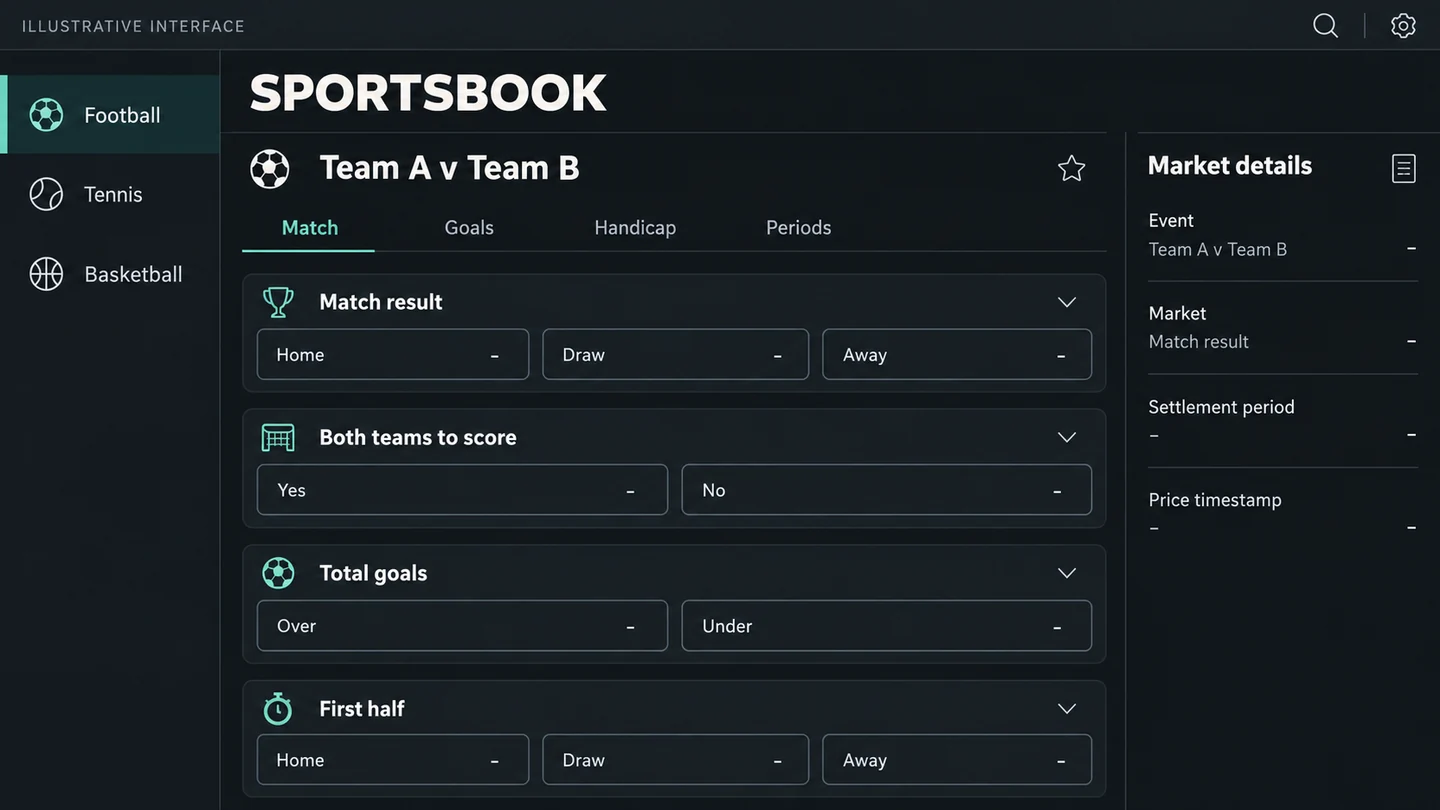
Curaçao sports betting covers online markets offered by bookmakers, also called bookies or sportsbooks. A sportsbook deserves its own assessment: a casino can have an extensive slots catalogue while offering a limited betting product. Equally, a familiar sports menu tells you little about the legal company holding the account. Separate the sportsbook's product quality from the evidence supporting its licence and availability.
| Priority | What to compare | Evidence to keep |
|---|---|---|
| Licence & eligibility | The account operator, approved domain and your country's restrictions. | Dated official record, domain certificate and relevant terms. |
| Sports & markets | The competitions and bet types you need, not just a total sports count. | The specific event, market and settlement conditions. |
| Odds & limits | Prices for the same outcome at the same time, plus stake and payout caps. | Displayed price and, where lawfully tested, the accepted bet receipt. |
| Withdrawals | Currency, fees, verification, withdrawal caps and processing stages. | Written cashier rules; actual receipt times only where documented. |
| Offers & support | Qualifying odds, eligible markets, expiry and the complaints procedure. | Full promotion terms and a dated response to a specific question. |
Keep advertised features separate from observations. A bookmaker's stated processing time is not our measured withdrawal time; a market count is not proof of competitive prices. Our review methodology explains the evidence required before an operator recommendation can be published.
The same football-rule questions were checked against three brands' public documents. Their CGA domain certificates name the same company, Santeda International B.V., and licence reference OGL/2024/1798/1048. These are therefore three branded websites, not three independent licensed businesses. The comparison concerns written conditions, not service ratings, betting tests or UK eligibility.
| Rule examined | Zizobet | Cosmobet | Velobet |
|---|---|---|---|
| Pre-match football postponement | 24-hour window in the pre-match section. | 24-hour window in the pre-match section. | 24-hour window in the pre-match section. |
| Live-football postponement | 48-hour window in the live section. | 48-hour window in the live section. | 48-hour window in the live section. |
| Cash-out restrictions | Unavailable above odds of 8.0 or for accumulator tickets with more than seven events. | The same odds and event-count restrictions are published. | The same odds and event-count restrictions are published. |
| Displayed live information | Stream time and statistics are described as informational, without an accuracy guarantee. | The same qualification appears in the football rules. | The same qualification appears in the football rules. |
Sources: Zizobet sportsbook rules, Cosmobet sportsbook terms and Velobet sportsbook terms. The postponement clauses include exceptions and distinguish outcomes already determined before an interruption. The cash-out clauses also depend on the event remaining available in live betting. These summaries are not universal rules for every sport or ticket.
The similarity is itself a finding: different branding does not establish different settlement protection. A 48-hour live-football clause should not be applied to a pre-match ticket governed by the separate 24-hour clause. For a disputed settlement, preserve the ticket, the applicable section and the event record; a screen clock alone cannot establish when a bet was accepted.
The three linked domain certificates displayed Active when inspected, but a domain certificate is not a service-quality assessment or permission to serve every country. The earlier company-register qualification remains explained in our worked licence check. The casino comparison links the individual domain records; this rule comparison does not rank one brand above another.
Curaçao sports betting sites must be assessed against both their account restrictions and the rules for the customer's location. A business offering remote betting on real events to customers in Great Britain needs the relevant Gambling Commission licence. A UK country option at signup does not establish that the operator holds that permission.
The UKGC's remote real-events betting licence guidance distinguishes real sports betting from other gambling activities. A casino licence entry, a software supplier's licence or permission for virtual events is not interchangeable evidence. Match the legal business and the type of activity, not just the brand name.
For Curaçao betting sites for UK players, there are three separate questions: does the website let you register, do its terms permit your location, and does the operator have the necessary authorisation? Treat conflicting answers as unresolved. Northern Ireland has a separate legal framework; the Great Britain licensing explanation should not be stretched into a blanket answer for every UK resident.
For casino games rather than sports markets, use the separate Curaçao casinos guide for UK players. A positive impression of one product should not substitute for checking the other.
Curaçao bookmakers and UKGC-licensed bookmakers differ principally in their regulatory obligations and the account terms governing the customer relationship. Sports coverage, odds and service quality still vary by operator in either group. Compare the rules that apply to your account rather than assuming an offshore bookmaker automatically offers higher limits, better prices or fewer checks.
A British betting licence brings the operator within UKGC supervision for the licensed activity. A Curaçao-only licence does not recreate that relationship. The CGA states that it does not settle individual player disputes or order compensation. Identify the bookmaker's own complaints process and any named independent dispute service before relying on either regulator's logo.
Use matching events and settlement rules when comparing Curaçao online bookmakers. A 90-minute football market and a market including extra time are different bets, even if the selection names look similar. In-play prices change quickly, so a useful comparison records the time as well as the event.
For example, a £10 stake at decimal odds of 2.00 returns £20 if it wins, including the stake. At 1.90 the return is £19. These are illustrative prices, not operator quotes, and they do not predict whether the selection will win.
For a hypothetical two-outcome market with no draw or other outcome, prices of 1.90 on both sides imply 52.63% each: 100 divided by 1.90. Together they total 105.26%, an overround of 5.26 percentage points above 100%. Prices of 1.95 on both sides total 102.56%, or 2.56 points above 100%.
The second example has a smaller built-in pricing margin for that market. It is not a promise of profit, a precise personal loss rate or proof that the bookmaker is better across every sport. Include every possible outcome, and compare the same market, rules and moment. A three-way football market needs the draw price too.
Separate maximum stake, maximum winnings and withdrawal limits. A site may advertise a high payout ceiling while limiting a particular market or account. A Curaçao licence is not a promise of unlimited stakes or document-free withdrawals. Read the verification rules before treating a simpler signup process as an advantage.
For illustration, a £10 winning stake at 6.00 produces a £60 return and £50 profit. If the applicable rule caps profit at £40, the return would instead be £50 including the stake. A separate £25-per-day withdrawal ceiling would then limit how quickly that balance could be transferred, not how the bet was priced. These are fictional conditions; check whether a real cap refers to profit, total return, one event or an account period.
Compare a betting offer on its own terms: minimum qualifying odds, eligible bet types, whether a free-bet stake is returned and the expiry date. Casino wagering and sportsbook qualifying bets are not equivalent. Declining a promotion can be the better choice if its conditions would change your planned spending.
A hypothetical £10 stake-not-returned free bet winning at 3.00 pays £20, not the £30 total return of a £10 cash bet at the same odds. The promotional £10 stake is excluded from the payout. If the qualifying bet must be at least 2.00, a cash bet at 1.90 would not satisfy that condition. Neither example represents a current operator offer.
Also establish whether qualifying bets must settle before the deadline, whether voided or cashed-out tickets count, and whether minimum odds apply to every accumulator leg or only the combined price. A credit that expires unused or is subject to further wagering is not unrestricted cash. Do not place extra bets simply to rescue a promotion.
A new Curaçao betting site should be identified by a documented launch, not simply a recent review date or a refreshed logo. Check whether the brand, operating company and licence are actually new. A recently launched sportsbook has a shorter observable record, so clear terms and current licence evidence matter especially at the start.
Newness can describe several different changes: a new website from an established company, a new betting product on an existing casino, or a business starting its first brand. Those situations should not be presented as the same thing. A licence issue date also does not establish when a sportsbook first accepted customers. A rebrand, replacement domain or licence renewal is not, on its own, a new sportsbook launch.
Find a dated announcement or other attributable evidence identifying the brand and product. An undated homepage badge is not a reliable launch record.
Match the legal entity to its current licence and the domain certificate. Do not transfer the reputation of a similarly named business to the new site.
Published withdrawal times and opening promotions are claims to evaluate. They do not establish a track record of settled bets, withdrawals or complaint handling.
Our new Curaçao betting sites assessment separates brand-launch statements, sportsbook evidence and domain certificates. There is no need to open an account simply because a brand is new. If key information is missing, leave it out of your shortlist until the evidence catches up with the launch announcement.
Curaçao sportsbooks publish their own conditions: check the market's settlement rules, the accepted odds, maximum winnings, withdrawal conditions and account controls. Save the rules that apply to the bet, not just the promotional banner. The practical test is whether you can explain how a winning, voided or disputed selection would be handled.
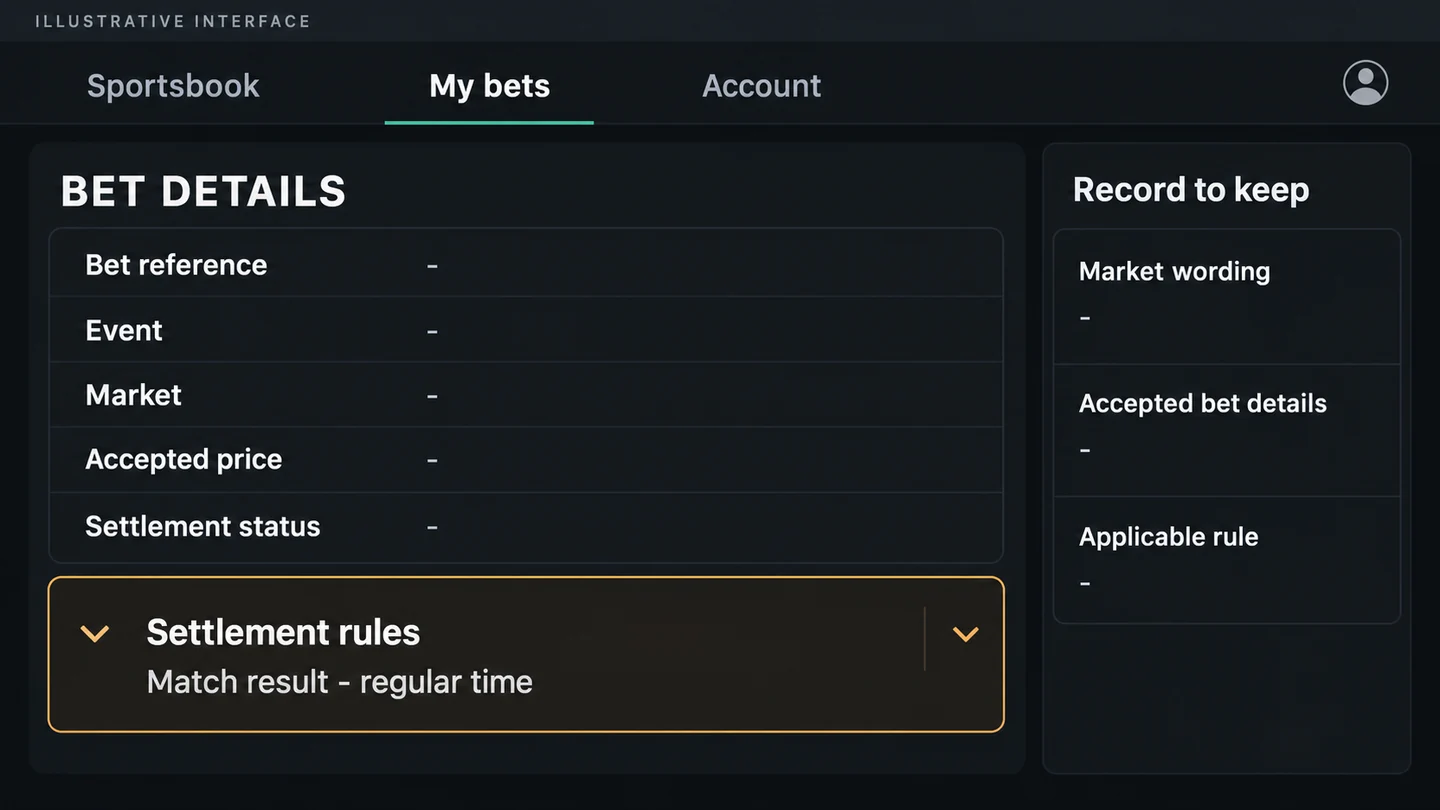
Check the competition and selection you need. A football menu might include match result but omit player shots, cards or a lower-league fixture. For tennis, match winner, set winner and total games are separate products. Esports, simulated sports and horse racing also need their own event definitions and rules; a large combined sports count says little about any one of them.
Record the event, start time, market name, line and settlement period. Over 2.5 goals and over 3.5 goals are not comparable prices. Nor are a pre-match selection and an in-play selection taken after a goal. An absent market is a product limitation, not evidence of a poor price.
Suppose a cup match is 1–1 after 90 minutes plus stoppage time, then the home team wins in extra time. A bet on the home team in a market explicitly limited to regular time loses; a separate home-team-to-qualify bet can win. Stoppage time and extra time are different periods. This is an illustrative settlement under those stated market definitions, not a rule for every football bet.
Abandonment creates another distinction: has the relevant outcome already been decided? A first-goal market may be determined before a match stops, while the match-result market remains unresolved. Read the bookmaker's resumption window, the relevant pre-match or live subsection, and its exceptions for settled outcomes. Postponement does not automatically mean immediate repayment.
If a tennis player retires after the first set, a match-completion rule could void the match-winner bet, while a rule allowing settlement after one completed set could produce a win or loss. An already-completed first-set market is a separate question. These are contrasting hypothetical rule structures, not a claim about Zizobet's retirement policy. Establish the specific retirement clause and minimum-play requirement before comparing odds.
For horse racing, distinguish an ante-post bet from a non-runner-no-bet market. Under an all-in ante-post condition, a selection that never starts can lose; under a non-runner-no-bet condition, its stake is returned. Each-way bets split the stake into win and place parts. Compare the place fraction, number of paid places and any withdrawal-related deductions, not just the win price. The Betfair non-runner explanation illustrates these distinctions in a UK product; its rules should not be assumed to apply to a Curaçao bookmaker.
Under a rule that substitutes decimal odds of 1.00 for a void selection, a £10 treble at 2.00 × 1.50 × 3.00 would become 2.00 × 1.00 × 3.00. If both remaining selections win, the return is £60 rather than £90. The whole ticket is not necessarily refunded, and a remaining losing selection can still make it lose.
This is a worked calculation, not a universal policy. Bet builders, related selections, boosts and free bets can have different cancellation rules. Check whether removing a leg also removes a promotion or leaves the ticket below its minimum qualifying leg count.
Distinguish a displayed price from a confirmed bet. Check how the bookmaker handles odds changes, rejected stakes and events that are suspended before acceptance. Cash-out, where offered, can change or become unavailable; it should not be treated as a guaranteed exit from a losing position.
Establish the withdrawal method before depositing. Ask whether the quoted time begins at the request, approval or transfer stage, and whether verification is excluded. For cryptocurrency, confirm the asset, network and fees. Neither a crypto option nor a sterling display establishes UK eligibility or authorisation.
A winning ticket, an available cash balance, an approved withdrawal and money received are four different stages. An unsettled bet or bonus restriction can prevent funds becoming withdrawable; an account check can delay approval; a payment-provider delay can follow approval. Ask which stage is holding up the request instead of treating every delay as a betting-settlement error.
Ask something the general rules leave unclear: for example, which clause applies if a tennis player retires in the second set. Save the answer and compare it with the written policy. Friendly service is welcome, but an answer that contradicts the terms needs clarification, not a higher review score.
For a disputed football result, provide the bet reference, accepted price, market wording, acceptance time, recorded result and the clause you believe applies. State the correction sought: for example, settlement as a draw under the ticket's regular-time rule. Ask the operator to identify the rule and result source used, then retain its written explanation.
If support does not resolve the issue, use the operator's formal complaint form and request its independent ADR details. The CGA complaints policy provides for escalation to independent dispute resolution, free to the player. It separates that process from the CGA's supervisory role. Report an in-play issue promptly because relevant event data may become harder to establish; a licence seal does not decide the disputed ticket.
Set the limit before the fixture. Decide what you can afford to lose and how long you will spend. Do not increase a stake to recover a previous loss, and do not move to another bookmaker to bypass an account restriction. Our responsible gambling guidance includes independent support.
Check a Curaçao betting licence by matching the sportsbook's legal operator with the official CGA records and its exact domain with the appropriate operation certificate. Record the status and dates shown. A company's licence certificate alone does not establish that the website accepting your bets is an approved player-facing domain.
Bookmakers with a Curaçao licence should be assessed at the website level as well as the company level. The account operator is the entity responsible for the player's balance; it is not necessarily the business supplying the sportsbook software. The CGA's domain-management guidance distinguishes supplier certification from a player-facing domain's Certificate of Operation. Our Curaçao gaming licence check covers the register, certificate and domain checks, including what to do when a record cannot be confirmed.
If you arrive from a casino page, compare the legal company again when opening the sportsbook. A shared brand or login does not remove the need to establish which terms govern the betting account.
No. A bookmaker takes bets on sports or other events, while a casino offers games such as slots and roulette. One brand can provide both, but the products may have different rules or operating arrangements. Compare the sportsbook itself rather than transferring a casino review score to its betting service.
Only if that operator supports a sterling account and a payment route available to you. A pound symbol on the website may be a display conversion. Check the currency of the bet, the balance and the withdrawal, together with any conversion costs and the relevant country restrictions.
No. Limits depend on the bookmaker, sport, market and account, not simply the licensing jurisdiction. Separate a maximum stake from a maximum payout and a withdrawal cap. An advertised headline limit may not apply to your selection, and a large limit does not make a bet better value.
Do not assume that it does. Check the activity covered by the operator's permission and the rules for your location. The UKGC distinguishes remote betting on real events from virtual events. A reference to a general betting product does not establish that every activity offered is covered.
Keep the bet reference, accepted odds, event and market details, settlement result and the relevant rules. Ask support to identify the clause used and save the response. Follow the operator's formal complaints process if the explanation remains disputed; a regulator's licence record is not itself a compensation service.
Regulatory sources reviewed: UKGC real-events betting guidance, CGA online gaming guidance and CGA certificate policy. Source review is not a real-money operator test.